Cobalt Beyond the Bosphorus: The Quiet Migration of Iznik Patterns Into American Homes
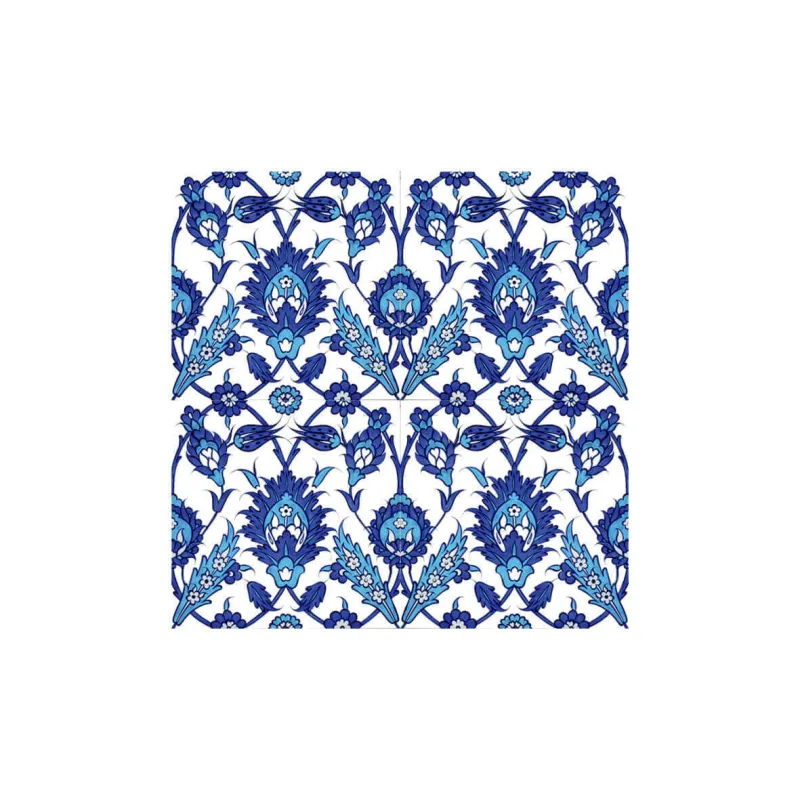
Photo: Iznik blue and white ceramic tiles tulip pattern close up, via www.iznikcini.com
Walk into enough American kitchens lately and you will notice a recurring vocabulary: cobalt blue against creamy white, tulips and carnations rendered in coral, saz leaves curling across a range hood. Most homeowners can name the look — Mediterranean, maybe, or Moroccan — but few can name its origin. The patterns now tiled across millions of square feet of American countertop were born not on the Mediterranean at all, but in the kilns of Iznik, a small Anatolian town that supplied the Ottoman Empire for over two centuries.
How a sixteenth-century ceramic tradition, once reserved for the walls of the Süleymaniye Mosque and the sultan's palace, became a design dialect spoken from Portland to Providence is a story about trade, Instagram, and the strange speed at which ornament travels in the twenty-first century.
A Kiln Town Becomes a Visual Language
Iznik's golden age ran roughly from the late 1400s through the 1500s, when court-sponsored workshops perfected a quartz-rich body and a signature palette — deep cobalt, turquoise, and later the famous bole-red coral that made the ceramics glow like enameled jewelry. The designs were never casual decoration. Tulips, hyacinths, and cypress motifs carried connotations of paradise gardens; the compositions were mathematical, often drawn by palace designers and transferred to workshops as templates.
That is precisely what makes the current American moment complicated, argues Deniz Ayanoğlu, a design historian who lectures on Ottoman ornament. "These patterns encoded a whole cosmology. When they migrate, they don't arrive with their grammar — they arrive as vocabulary only. A tile is a fragment by nature."
The Brooklyn Kiln
On a rainy afternoon in Gowanus, ceramicist Mara Ellison pulls a tray of hand-painted tiles from her kiln: tulip-and-cloud compositions in unmistakable Iznik blues. She is candid about her sources. "I studied the originals at the V&A and in Turkish museum catalogs. I'm not copying — I'm in conversation. But I've had clients ask for the pattern 'without the weird flowers,' and that's when I have to explain that the flowers are the pattern."
Ellison's studio is one node in a growing network. American tile makers report that requests for Iznik-inspired work have tripled in five years, driven partly by the backlash against sterile minimalism and partly by social media, where hashtags like #izniktiles and #mediterraneancore have accumulated millions of posts. The aesthetic photographs beautifully — saturated, symmetrical, instantly legible in a thumbnail — and Instagram, more than any design magazine, has been its distribution engine.
From Mosque Wall to Forearm
The migration has not stopped at interior design. Tattoo artists across the US report a steady demand for Iznik motifs, often wrapping tulips and rumi scrollwork around forearms and ribs. Unlike a backsplash, a tattoo is worn on the body, which raises the stakes of the borrowing question.
"When someone puts a pattern on their skin, I want them to know where it's from," says Ozan Kaya, a Turkish-American tattooist in Chicago who frequently fielded requests during the trend's 2023 peak. "Some clients light up when I explain the history. Others just want it to look cool. Both exist. The second one used to bother me more than it does now."
Kaya's ambivalence captures the debate neatly: is adaptation betrayal, or is it simply how visual culture has always worked? The Iznik workshops themselves absorbed Chinese motifs from imported porcelain, transforming dragons and peonies into tulips and clouds. Ornament, historically, has never respected borders.
Adoption, Adaptation, or Flattening?
The critics' worry is less about borrowing than about flattening — the reduction of a complex tradition to a color scheme. When a pattern is described as "Moroccan" or "Boho," its history evaporates. When it is mass-printed on peel-and-stick vinyl by a supplier with no connection to ceramics at all, something else is lost: the material intelligence of a craft that took generations to perfect.
Yet there are counterweights. Interest in the source has measurably grown; American museum exhibitions of Ottoman ceramics have drawn record attendance in recent years, and Iznik's own foundation-run workshops have seen a surge in international students and commissions. Some designers are deliberately citing their references, crediting Iznik by name in project write-ups and working with Turkish ateliers rather than imitating them.
"The worst outcome isn't appropriation," Ayanoğlu says. "It's amnesia. A tulip on a tile in Ohio can be an empty signifier or an open door. It depends on whether anyone bothers to open the door."
What the Pattern Carries
Standing in Ellison's studio, watching steam rise off a fresh kiln load, it is hard to see the situation as purely a cautionary tale. The tiles are beautiful. The colors are doing exactly what they were designed to do centuries ago — pulling the eye toward something luminous. That a Brooklyn ceramicist and a mosque in Edirne can share a visual sentence, across four hundred years and an ocean, is not a small thing.
The question for American design culture is whether it will keep learning the language or merely keep wearing the accent. The tulips, patient as ever, will outlast the trend either way.