Reed Pens in the Age of the Keyboard: Inside America's Quiet Obsession with Ottoman Calligraphy
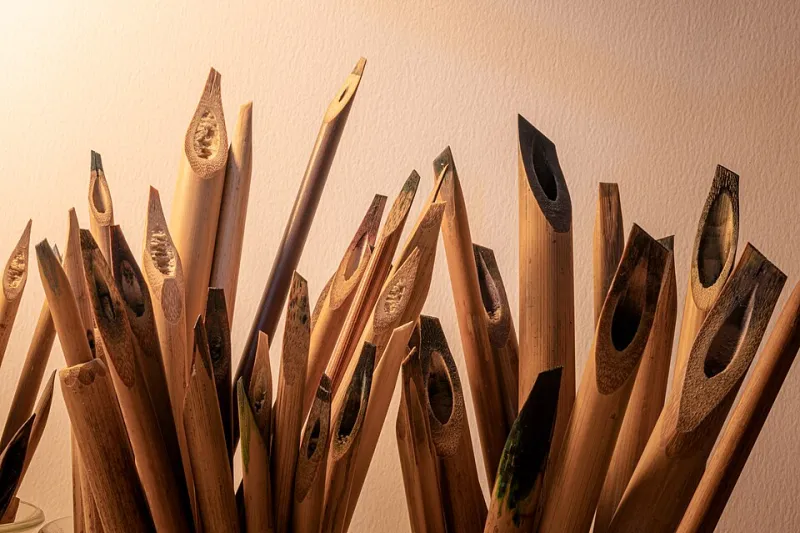
Photo: Faizal Somadi, CC BY-SA 4.0, via Wikimedia Commons
On a rainy Thursday evening in a converted warehouse in Gowanus, twelve adults sit in silence around a long table, each holding a cut reed pen known in Turkish as a kamış kalem. There are no laptops open. There is barely any talking. The only sound is the scratch of nib against paper as the students practice a single letterform — the sweeping elif, a vertical stroke that, in the Ottoman tradition, is considered the first and most essential act of learning to write.
Scenes like this are no longer rare. From Brooklyn art collectives to design departments in Los Angeles and weekend intensives in Chicago, Ottoman and Turkish calligraphy — hat in Turkish — is experiencing an unexpected American moment. It is a curious development for an art form whose golden age unfolded centuries ago in imperial workshops of Istanbul, and one that says a great deal about what digital-era Americans feel they are missing.
A Discipline Built on Restraint
Classical Ottoman calligraphy is not a hobby one picks up casually. Traditionally, a student trained under a master (hocası) for years, often writing nothing but the elif for months before being permitted to compose full words. The tools themselves are handmade: reeds harvested and carved to precise angles, inks ground from soot, and a smoothed surface of ahar-treated paper that allows the pen to glide without bleeding.
What American newcomers discover, often with some surprise, is that this rigor is precisely the appeal. In a culture where creative fulfillment is frequently promised through shortcuts — a weekend workshop, a downloaded app, a thirty-day challenge — hat offers the opposite proposition. Progress is slow. Mastery is measured in decades. And the body, not the screen, is the instrument.
From Istanbul to the Studio
The teachers driving this movement are often Turkish calligraphers trained in the icazet system, the traditional license granted by a master upon completion of formal study. Some arrived in the United States as graduate students or working artists; others now teach remotely, reviewing students' practice sheets over video calls between sessions in Istanbul.
The pandemic, paradoxically, accelerated the trend. When studios closed, instruction moved online, and a student in Portland could study under a master in Üsküdar. By the time in-person classes returned, a network of enthusiasts had already formed — graphic designers, type foundry employees, tattoo artists, and a notable contingent of tech workers seeking refuge from their own devices.
Museums have taken notice as well. American institutions with significant Islamic art collections, from the Metropolitan Museum of Art to smaller university galleries, have seen renewed public interest in their calligraphic holdings, and some now host demonstrations alongside their exhibitions.
Why Now?
Several currents converge here. The broader revival of analog craft — letterpress printing, bookbinding, hand-thrown ceramics — has prepared a receptive audience. The growing visibility of Islamic art in American cultural life has removed some of the distance and unfamiliarity. And a certain fatigue with digital production has made the utterly non-scalable nature of calligraphy feel less like a limitation and more like a luxury.
There is also, practitioners suggest, a spiritual dimension that transcends religious boundaries. While hat is inseparable from its origins in Qur'anic transcription and Ottoman court culture, many American students approach it as a meditative discipline rather than a devotional one. The repetition, the breath control, the surrender of personal expression to inherited form — these elements resonate with a generation fluent in mindfulness but hungry for something with deeper roots.
The Question of Authenticity
Not everyone in the field welcomes the boom uncritically. Some traditionalists worry that abbreviated workshops flatten a demanding art into an aesthetic accessory, divorcing beautiful letterforms from the centuries of discipline that gave them meaning. Others counter that every tradition survives through newcomers, and that the American appetite for hat — however partial or imperfect — keeps alive an art that many in Turkey itself struggle to sustain.
The truth likely lies somewhere in between. The students in that Gowanus warehouse will probably never earn an icazet. Their elif will never hang in a museum. But each Thursday, they pick up a reed pen cut by hand, dip it in soot-black ink, and try again — slowly, imperfectly, deliberately — to learn what a stroke of the pen once meant.
In an age when nearly everything is typed, scrolled, and instantly discarded, that may be the most universal cultural act of all.