Karaköy to Kansas City: The Family Workshops Selling Centuries of Craft, One Five-Star Review at a Time
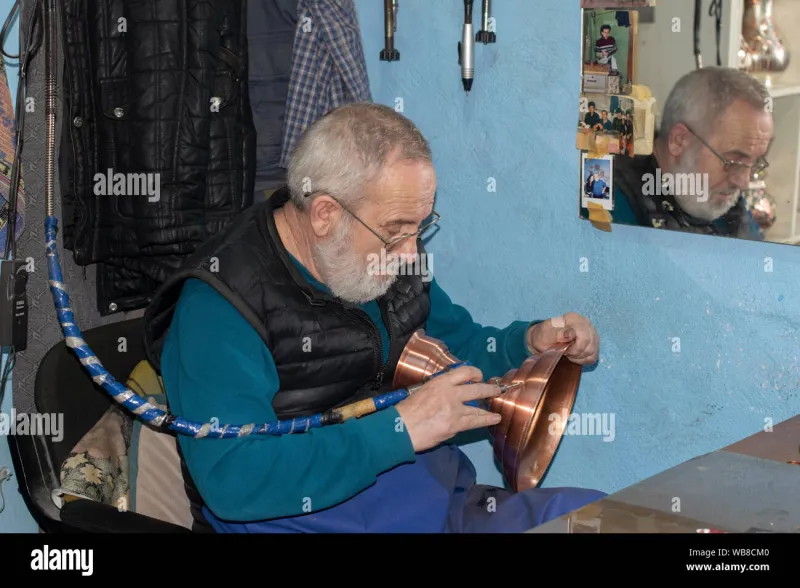
Photo: Turkish coppersmith artisan workshop hammering brass Istanbul, via c8.alamy.com
On a narrow street above the Golden Horn, a third-generation coppersmith named Hakan Yıldırım does something his grandfather would have found baffling: he photographs a candlestick against a white foam board, adjusts the exposure on his phone, and writes a product description in careful English. Within hours, the piece — hand-hammered, signed on the base, wrapped in acid-free tissue — will be on its way to a buyer in Portland, Oregon.
Yıldırım is one of a growing cohort of Turkish artisan sellers who have moved from the covered markets of Istanbul and the bazaars of Gaziantep onto Etsy, Amazon Handmade, and Instagram. Their arrival has been largely unchronicled, but their presence is unmistakable to anyone who has scrolled the platform's home-decor listings and noticed a certain patina — literally and figuratively — that mass-produced goods cannot fake.
From the Han to the Homepage
The traditional structure of Turkish craft commerce was built for face-to-face trade: the han, or caravanserai, where workshops and salesrooms shared a courtyard; the negotiated price; the tea offered before the transaction. E-commerce has dismantled nearly all of it. Prices are fixed and posted. The tea has been replaced by an automated shipping notification. And the buyer, 6,000 miles away, will never run a thumb along the hammer marks.
What has survived — and, sellers say, become more valuable than ever — is provenance. "In the bazaar, I could tell my grandfather's story in two minutes and it helped sell the tray," Yıldırım says. "On Etsy, the story is the product. Without it, I am just a photograph of brass."
That realization has produced a peculiar literary genre: the product listing as family memoir. Descriptions routinely reference grandfathers' workshops, the specific districts where techniques were learned, and the Ottoman lineage of a form. American buyers, raised on a craft-ethics vocabulary of "small batch" and "maker," appear to be reading closely. Several of the most successful Turkish sellers report that listings with detailed provenance convert at two to three times the rate of bare product shots.
The Gaziantep Test Kitchen
Two hours' flight to the southeast, in Gaziantep — a UNESCO-recognized gastronomic capital — the model looks different. There, the trade is less about objects and more about flavor. Micro-batch spice blends built around biber salçası, Urfa pepper, and sumac have found a devoted American following among home cooks who discovered Anatolian cooking through cookbooks by Musa Dağdeviren and the popularization of çığırtma and alinazik on food media.
Nuray Şen, who runs a small blending operation with her sister, describes the American customer as demanding in unexpected ways. "They ask about heat level like it is a medical question," she laughs. "They want to know the farm. They want the harvest year for pepper. In Antep, no one asks the harvest year."
The logistics, however, are unforgiving. International shipping from Turkey can take two to three weeks; customs paperwork for food products is a minefield; and a single damaged shipment can trigger a refund and a review that lingers like a stain. Şen now vacuum-seals every order and includes a handwritten card in English — a practice she borrowed, she admits, from watching American sellers on YouTube.
The Review Economy Meets the Apprentice System
The deeper tension in this story is cultural. Turkish craft training is built on the ustalık–çıraklık system — master and apprentice — in which skill is transmitted over years and authority is hierarchical. The review economy is flat, immediate, and unforgiving. A coppersmith with forty years of experience is one disappointed customer away from a three-star rating that mentions "shipping took forever" as though it were a flaw in the metalwork.
Sellers have adapted with varying degrees of grace. Some have hired English-speaking family members to manage customer messaging. Others have leaned into the review system itself, photographing their workshops, filming the hammering process, and effectively turning the studio into content. The result is a hybrid identity — part artisan, part influencer — that sits uneasily with some older craftsmen but has proven remarkably effective at building trust across an ocean.
There is also a quieter economic consequence. For workshops squeezed by domestic inflation and a weak lira, dollar-denominated sales have become a lifeline. Several sellers describe their Etsy shops as what keeps the apprentice system alive at all: without export income, the next generation simply leaves the trade.
What the Buyer Is Actually Buying
It would be easy to frame all of this as simple commerce — and in part, it is. But there is something more interesting at work. The American buyer of a hand-hammered candlestick or a small tin of Urfa pepper is purchasing, alongside the object, a relationship to making that the domestic mass market largely no longer offers. The Turkish seller, meanwhile, is purchasing access to an audience that values the tradition enough to keep it economically viable.
Both parties, in other words, are buying time. Whether the usta at his bench and the customer in her kitchen can sustain that exchange — across time zones, shipping delays, and the abrasions of the review economy — may determine whether these crafts survive the century in anything more than museum form.
Back in Karaköy, Yıldırım has stopped worrying about it, or claims to have. "My grandfather sold to strangers and gave them tea," he says. "I sell to strangers and give them a story. It is the same tea, in the end."
His latest listing — a set of brass candlesticks, hammered, signed, tissue-wrapped — has forty-seven reviews. All five stars.