Dice, Coffee, and the Long Shadow of the Anatolian Board: Tavla's Quiet American Debut
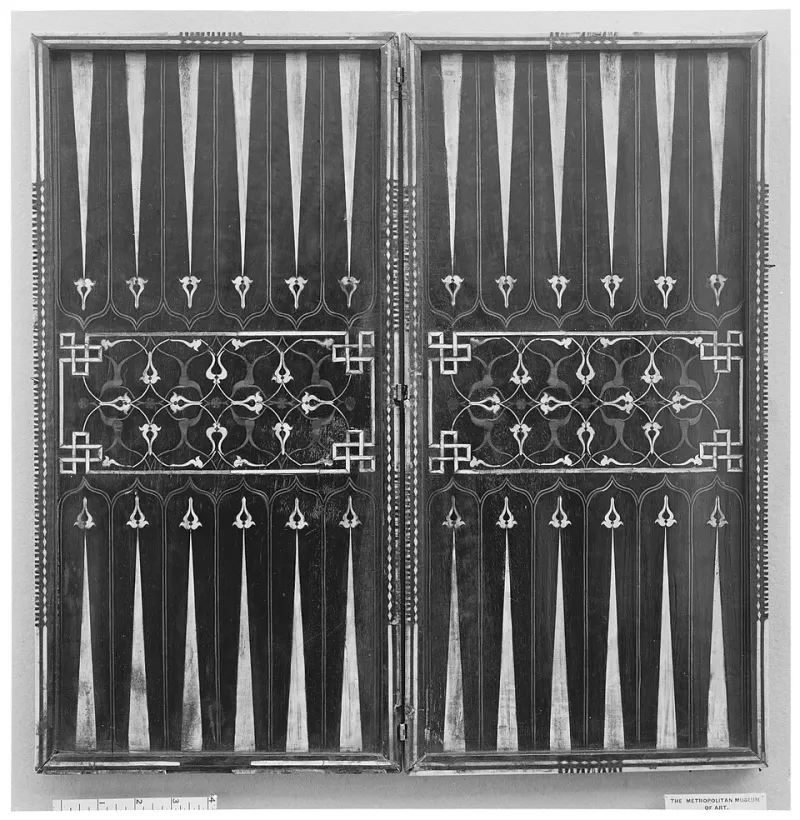
Photo: Unknown, CC0, via Wikimedia Commons
A Game That Refuses to Be Solved
There is a particular sound that fills certain Brooklyn cafés after sundown: the dry clatter of dice tumbling in a leather cup, followed by the sharp tap of checkers against wood. It is the sound of tavla — backgammon's Anatolian sibling — and over the past three years it has migrated, quietly and without ceremony, into the rhythm of American leisure.
Unlike chess, which arrived in the United States trailing prestige and streaming deals, tavla came by way of the kitchen table. It traveled in the suitcases of Turkish, Armenian, Greek, and Iranian immigrants, played on boards worn smooth by generations of thumbs. Its American resurgence is not a story of reinvention but of rediscovery — and it says something unexpected about what a tired, screen-saturated country is hungry for.
From the Café to the Classroom
The most striking frontier is not the café but the school. In Minnesota, where the trend has taken its most institutional form, a handful of public schools have folded board-game clubs into their after-school programs, and backgammon — along with mancala-style games with roots in the broader region — has emerged as an unlikely favorite. Teachers report something almost paradoxical: a game built on chance that teaches probability better than flashcards, and a game built on rivalry that somehow produces remarkably gracious losers.
The appeal is not hard to diagnose. Post-pandemic, American families have shown a documented appetite for analog play — jigsaw puzzles, card games, anything that requires two people to sit across from each other. Tavla offers all of that, plus a low barrier to entry. A child can learn the rules in fifteen minutes; a grandmaster can spend a lifetime refining the doubling cube. That asymmetry, common in Anatolian households where a grandmother might beat a grown grandson without apology, is precisely what makes it durable.
The Brooklyn Board
In Greenpoint and Bay Ridge, the trend has a distinctly diasporic engine. Café owners of Turkish and Levantine background found that customers lingered longer when a board sat on the counter. What began as furniture became programming: weekly tavla nights, informal ladders, eventually sanctioned tournaments with brackets and modest cash prizes.
One organizer, a second-generation Turkish-American who asked to be described only as a "hobbyist with spreadsheets," notes that turnout doubled between 2022 and 2024. "In Istanbul, nobody signs up for tavla. You just play," he says. "Here, Americans want a registration link and a rule sheet. Fine. Whatever gets them to the table."
The boards themselves have become objects of desire in the way that vinyl records once were. Handcrafted walnut sets, some inlaid with mother-of-pearl in the style of Anatolian and Levantine workshops, sell through American maker platforms at prices that would have seemed absurd a decade ago. The backgammon board has quietly joined the category of objects — the copper pot, the handwoven textile — through which Americans consume a version of the Mediterranean they cannot quite visit often enough.
What the Dice Know
Skeptics will note that backgammon is hardly foreign to the United States; the game flourished in 1970s America, complete with celebrity tournaments and its own brief disco-era glamour. What is new is the texture of the revival. The current wave is less about competition than about duration — about the peculiar intimacy of a game that forces conversation, that cannot be played alone, that rewards the player who pays attention to another human being's habits and moods.
That, perhaps, is the genuine cultural transfer at work. Tavla in Anatolia is not a hobby; it is a social contract, played over tea and endless negotiation, punctuated by proverbs and mock outrage. Its American students are learning not just the bear-off rules but the etiquette: the obligation to stay, the pleasure of a rematch, the understanding that the board is merely an excuse.
Whether the trend outlasts its novelty is an open question. Games rise and fall in the American imagination with the regularity of fashion cycles. But there is reason for optimism in the game's own logic: backgammon punishes impatience and rewards those who play the long position. Its new American players, scattered across school gyms and Brooklyn counters, seem content to wait — one roll at a time — for the culture to catch up to the board.