Behind the White Screen: The Ottoman Shadow Art Finding a Second Life on American Stages
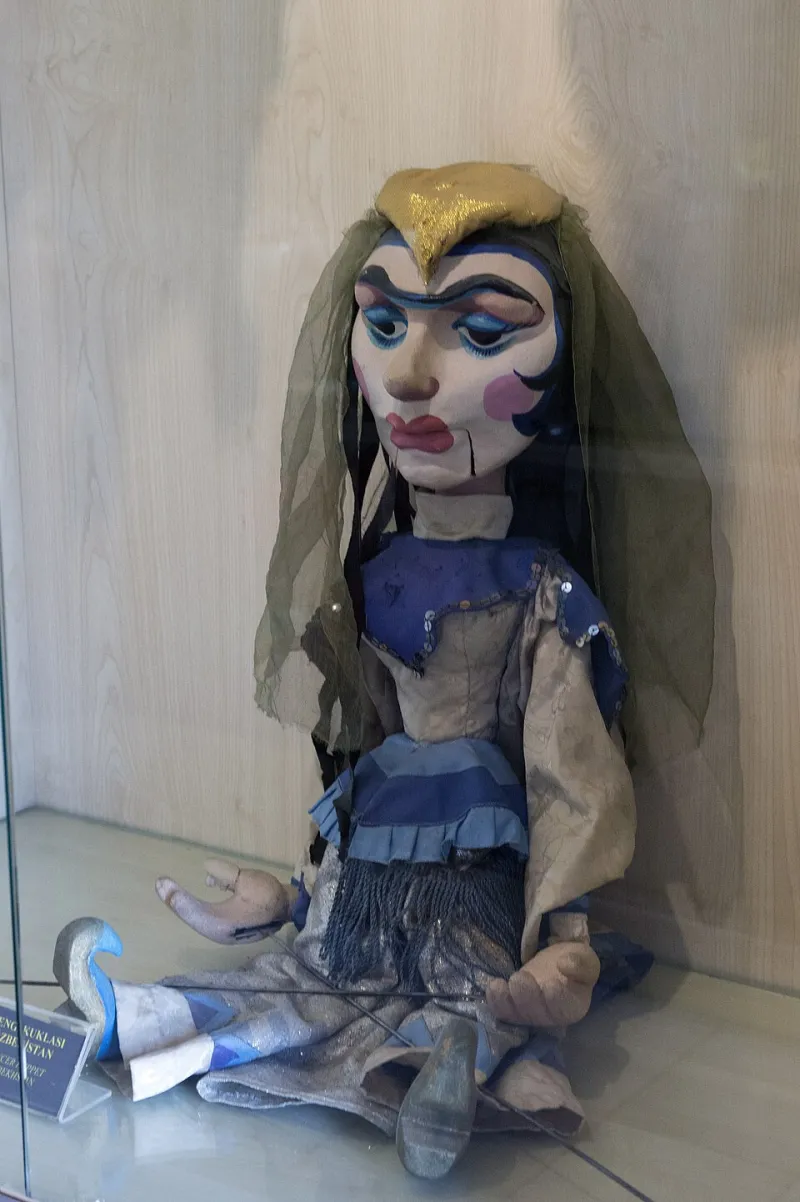
Photo: Dosseman, CC BY-SA 4.0, via Wikimedia Commons
There is a moment in every Karagöz performance that never fails to unseat a first-time viewer. The white screen glows. A shape flickers at its edge — then a figure strides in, all exaggerated limbs and swaggering confidence, and begins to argue with the audience in a voice like a rusty hinge. This is Karagöz himself, the Everyman trickster of Ottoman shadow theater, and he has been doing this routine for roughly seven hundred years. What is surprising is where he is doing it now: not only in Istanbul's coffeehouses, but in Brooklyn rehearsal studios, Midwestern university theaters, and the storyboards of American animators.
A Theater Made of Light and Leather
Karagöz takes its name from its central character — literally "black eye" — a blunt, unlettered everyman who outwits his pompous foil, Hacivat, an eloquent dreamer prone to verse. The pair may descend from real figures, or from folklore, or both; scholars have argued about their origins since at least the sixteenth century. What is certain is the form's architecture. Figures cut from translucent camel hide — the best puppets are stained with vegetable dyes and pierced with latticework so fine it resembles lace — are pressed against a muslin screen behind an oil lamp. A single puppeteer, the hayali, performs every voice, moves every figure, and orchestrates a cast that can include dandies, drunks, dervishes, and dancing beaux.
The result is a theater of pure silhouette: flat, luminous, and strangely modern. It is this visual economy — a story told entirely through shadow, silhouette, and suggestion — that has made Karagöz an object of fascination for Western artists since the nineteenth century, and it is precisely what makes the form feel newly relevant in an era of motion graphics and minimal design.
New York, Behind the Curtain
The American afterlife of Karagöz runs through a small but devoted network. Puppetry programs — most prominently the legendary program at the University of Connecticut, along with the workshops and archives of the Jim Henson Foundation orbit in New York — have long treated shadow theater as a foundational technique rather than an exotic curiosity. Graduate students in dramaturgy and design regularly encounter Karagöz alongside Javanese wayang kulit and the othello screens of Chinese opera as they study how light itself can be a performer.
Museums have done their part. The Metropolitan Museum of Art holds Ottoman puppet figures in its collections, and touring exhibitions of Turkish shadow theater have appeared at cultural institutions from Washington to Chicago. Meanwhile, a small circle of American collectors — some descended from mid-century diplomats posted to Ankara and Istanbul — have quietly assembled some of the finest private holdings of antique Karagöz figures outside Turkey. Their leather puppets, some two centuries old, occasionally surface at folk art auctions in New England, where they command prices that would have astonished the coffeehouse audiences who first laughed at them.
Shadows in the Storyboard
The more diffuse influence may be the one hardest to prove and easiest to feel. American animation has flirted with silhouette storytelling for a century — from the German Expressionist shadows of early Hollywood horror to the graphic flatness of certain independent shorts and title sequences. Designers working in theater and film frequently cite shadow-puppet traditions, Karagöz among them, when explaining why a flat, glowing figure can carry more menace or wit than a fully rendered one. The lesson of the coffeehouse screen — that limitation breeds invention, that a single lamp can build a world — has become a kind of design commonplace in American conservatory training.
There is also a quieter institutional story. Turkish cultural organizations in cities with sizable diaspora communities — New York, Washington, Los Angeles — have sponsored Karagöz performances and children's workshops, often pairing the art with language classes and heritage programming. These events draw two crowds at once: Turkish-American families seeking a familiar laughter, and American theatergoers drawn by the novelty of an art form that predates the proscenium stage.
Can a Flat Art Survive a Dimensional Age?
The skeptics have a point. Karagöz depends on live improvisation, on a hayali who reads the room and improvises new insults and new verses — an intimacy that recorded media struggles to reproduce. The traditional repertoire, dense with Ottoman-era dialects and local in-jokes, does not translate neatly, and some American presentations risk flattening the form into pure visual spectacle, all screen and no satire.
Yet the form's history argues for its adaptability. Karagöz survived the coffeehouse, the Republic's cultural reforms, cinema, and television, each time by finding new audiences willing to sit in the dark and watch shadows argue about power, money, and pretension. The subjects on the screen have changed; the argument has not. In an American cultural moment saturated with screens of every size, there is something almost pointed about an art that reminds us the screen itself was once a lamp, a cloth, and a very funny man behind it.
Whether Karagöz will ever be more than a cult enthusiasm in the United States is an open question. But the artists keeping it alive — the puppeteers teaching workshops, the designers borrowing its grammar, the collectors preserving its fragile hide figures — are betting on a simple proposition: that audiences raised on three dimensions still have room in their imaginations for two. The coffeehouse, after all, was never really about the coffee.