Turning Toward the Divine: How Sufi Whirling Became America's Unlikeliest Wellness Ritual
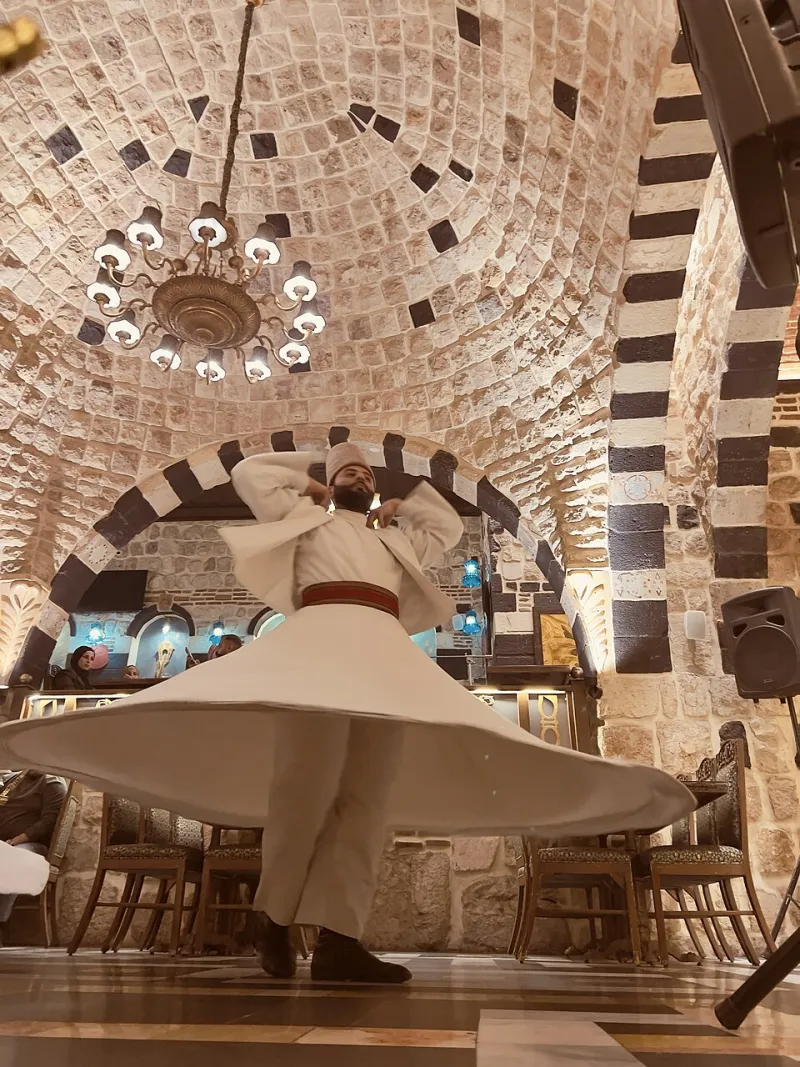
Photo: Tmnadili, CC BY-SA 4.0, via Wikimedia Commons
The Poet Who Sold a Million Paperbacks
Every December, lists of America's best-selling poets produce the same quiet surprise: somewhere near the top, again, sits a thirteenth-century mystic from Konya. Jalaluddin Rumi — jurist, theologian, and ecstatic — has become a fixture of American bookshelves, his verses clipped into wedding vows and tattooed onto forearms in translations that sometimes barely resemble the Persian originals.
But in the past few years, something curious has happened. Americans have stopped reading Rumi and started doing Rumi. The whirling ceremony of the Mevlevi order — the sema, with its white robes, its camel-felt hats, its slow orbit around a sheikh — has migrated from the mosque and the monastery into yoga studios, museum galleries, and wellness retreats from the Hudson to the Pacific.
From Konya to Culver City
The evidence is easy to find. In Brooklyn, workshops teaching the rudiments of turning — the crossed arms, the right palm lifted to heaven, the left to earth — routinely sell out within hours. In Los Angeles, the Getty and the Fowler Museum have both hosted sema performances that drew crowds more typical of a blockbuster retrospective. Even corporate retreats in the Hudson Valley have added 'whirling circles' to their itineraries, sandwiched between breathwork sessions and farm-to-table dinners.
The appeal is not hard to diagnose. American mindfulness culture, after two decades of dominance, has begun to feel bloodless to many practitioners. The app-guided breath, the silent retreat, the gratitude journal — these are techniques of quiet, but quiet is not the same as transcendence. Whirling offers something the wellness industry has struggled to manufacture: an experience that is physical, communal, musical, and — crucially — old. It comes with a lineage, a cosmology, a poet. In a marketplace saturated with secular stillness, the sema promises vertigo instead.
What the Ceremony Actually Is
Here lies the first complication. The sema is not, in its origins, a relaxation technique. It is a prayer — the Mevlevi order's liturgical reenactment of the soul's journey toward union with the divine. The dervish's rotation represents the motion of the planets; the removal of the black cloak symbolizes the shedding of the ego. The reed flute that opens the ceremony mourns, in Rumi's famous image, the soul's separation from its source.
To reduce this to 'moving meditation' is a bit like describing the Eucharist as a communal snack. The Mevlevis themselves, whose order was formally suppressed in Turkey in 1925 and survives today largely as a cultural institution, have watched their ritual become a global export with a mixture of pride and unease. Some perform willingly, seeing the audience as a doorway into the faith. Others describe the discomfort of praying while photographed.
The Commodification Question
Wellness culture, for its part, has shown little hesitation. Sema-adjacent experiences are now sold with the vocabulary of self-optimization: unlock your inner axis, find your center — literally. One Los Angeles studio offers a 'Whirl & Wine' evening that would have startled the dervishes of Ottoman Bursa. Online, sema-inspired choreography circulates in thirty-second clips, stripped of the prayers that frame it.
Yet the story is not purely one of extraction. Attendees at legitimate workshops frequently report something the marketing language cannot quite capture: the disorientation that gives way, after many minutes of turning, to an unexpected stillness. Some go on to read Rumi seriously — in A.J. Arberry's careful translations rather than the loose renderings of Coleman Barks. A few have sought out the Mevlevi cultural foundations in New York and elsewhere, where the ceremony is taught with its liturgy intact.
What Is Gained, What Is Lost
There is a defensible argument that every sacred practice that crosses a border undergoes this process. Yoga in America bears only a family resemblance to its Indian ancestors; Zen arrived in California already half-translated. The sema's American afterlife may simply be the latest chapter in a very old story of cultural travel — one in which distortion and devotion arrive on the same ship.
The harder question is whether the core survives the journey. Rumi's poetry, even in weakened translation, has led countless readers toward the tradition that produced it. Perhaps the whirling craze will do the same: a first, clumsy turn toward something deeper, the way a paperback of Rumi in a college bookstore was once a first, clumsy reading.
The dervish lifts his right hand to receive, his left to give. America, for now, is doing both — taking the ceremony and, occasionally, giving it the attention it asks for. Whether that trade enriches or empties the sema will be decided not in Brooklyn's studios but in whether the turning, for enough people, eventually stops being a trend and becomes a prayer.